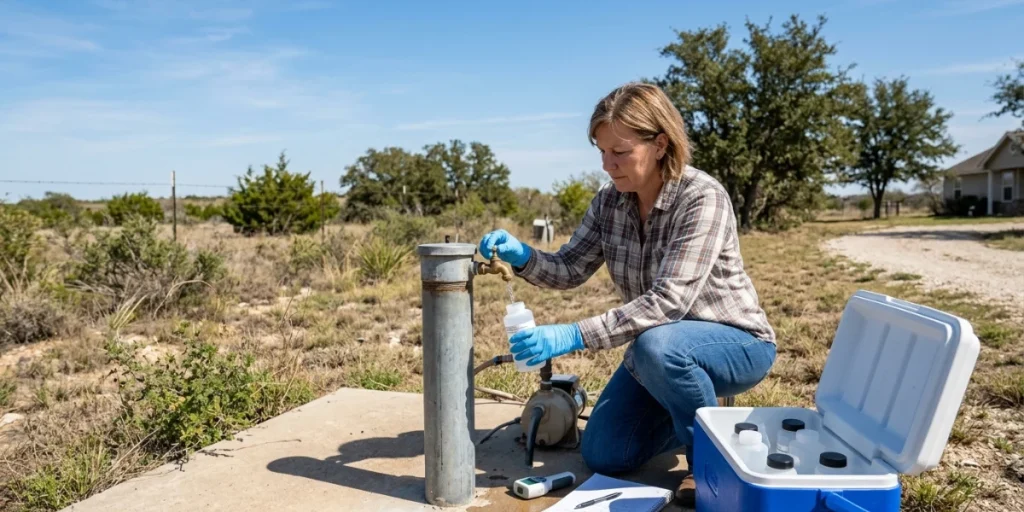
Private well owners in Texas carry a responsibility that most people never think about: there is no city utility sending a water-quality report to their door each year. You are entirely in charge of what comes out of your tap. And in a state where geology, agriculture, and unpredictable weather all shape what ends up in the ground, that is not a responsibility to take lightly. Well water testing in Texas is a critical part of safe well ownership, yet many well owners go years without testing their water.
Water can look clear, smell fine, and still carry contaminants that cause harm over time. A proper lab test is the only reliable way to know what is actually in your water. This guide covers the key contaminants to test for, how often to test, and what to do when results indicate a problem.
Why Private Well Owners in Texas Need to Test Their Water
Texas has millions of private water wells, and not a single one is monitored by a government agency on your behalf. Monitoring water quality in public systems falls under the Texas Commission on Environmental Quality (TCEQ), but private wells are entirely outside that oversight. What comes out of your tap is your call to manage.
Most water problems are invisible. Bacteria, nitrates, and arsenic have no taste, no smell, and no color. Your risk also shifts depending on where you live, how close you are to farmland, and how well your wellhead is sealed after heavy rain.
The Texas Well Owner Network (TWON) screens wells statewide and finds that 15-20% test positive for coliform bacteria. Annual testing is their standard recommendation, and it is the easiest way to catch a problem before it becomes a health issue.
Common Well Water Contaminants in North Houston
The water quality concerns in this region reflect its geology, its proximity to agricultural land, and the mix of suburban and rural properties across Montgomery County and Magnolia.
Coliform Bacteria and E. coli
Coliform bacteria are the most common problem found in private wells across Texas. E. coli is especially concerning because it points to contamination from human or animal waste. A damaged casing, a loose well cap, or storm runoff are the usual ways bacteria get in.
Nitrates
Nitrates have no taste, smell, or color, so you cannot detect them without a test. They come from fertilizer runoff and failing septic systems. High levels are most dangerous for infants under six months and can lead to a serious condition called blue baby syndrome.
Iron and Manganese
These minerals are common in groundwater across the greater Houston region. Iron above 0.3 mg/L leaves red-orange stains on sinks, laundry, and appliances. Manganese above 0.05 mg/L causes black staining and, at higher concentrations, can affect neurological development in children.
Arsenic
Arsenic is a naturally occurring element that moves silently into groundwater, leaving no taste or smell behind. Long-term exposure is linked to certain cancers, skin damage, and cardiovascular disease. It is worth including in any comprehensive water test, regardless of your location.
Hydrogen Sulfide
A rotten-egg smell from your tap is a clear sign of hydrogen sulfide. It is common in Gulf Coast aquifer regions and can be harmful at high concentrations. The smell alone is reason enough to get the water tested.
Total Dissolved Solids and pH
High TDS levels make water taste off and quietly wear down your appliances over time. pH indicates how acidic or basic your water is, and acidic water can corrode pipes over time. Both are standard measurements in most well water test panels.
What a Water Quality Test in Magnolia, TX Should Include
A water quality test should go beyond a basic bacteria check. Below are the key components a solid well water test should include.
Basic Panel: The Starting Point
A basic test covers coliform bacteria, E. coli, nitrates, and pH. This is the minimum you should test for every year. TCEQ and Texas A&M AgriLife Extension both recommend annual testing for bacteria and nitrates as a baseline for all private well owners in Texas.
Metals Panel
A metals panel checks for iron, manganese, arsenic, lead, copper, and other heavy metals. This is especially important if you have older plumbing, live near industrial areas, or have never had your well tested before. Lead, in particular, can come from pipes or fixtures inside your home rather than the groundwater itself.
Comprehensive Water Analysis
A full analysis adds total dissolved solids, water hardness, sulfates, chlorides, and additional chemical parameters. This level of testing is helpful if you are buying a property with an existing well, if you have had issues in the past, or if anyone in your household has specific health concerns. It gives you the most complete view of your water quality.
PFAS Testing
PFAS (per- and polyfluoroalkyl substances) are man-made chemicals that have been detected in groundwater near industrial sites and military bases. These chemicals do not break down naturally and tend to collect in the body over time. For well owners near areas with known PFAS contamination, adding this test to your panel is a wise move.
Post-Flood and Post-Event Testing
Whenever your area experiences significant flooding, test for bacteria and nitrates at a minimum. Floodwaters carry surface contamination directly to poorly sealed wellheads. This test is separate from your annual testing schedule and should happen as soon as possible after the event.
How Often Should You Test Your Well Water?
Testing frequency depends on your well’s age, your location, and any changes in your home or surrounding land.
At a minimum, test your well for bacteria and nitrates every year. That is the standard recommendation from the Texas Well Owner Network and Texas A&M AgriLife Extension. Beyond that, some situations call for immediate testing. After any flooding, get a sample to a certified lab as soon as it is safe to do so. A rotten-egg smell, cloudy water, or an off taste are also signs to test right away, not at your next annual checkup.
Before buying any property with a private well, a well water inspection in Montgomery County, TX, should be part of the process so you know exactly what you are getting into.
Some households need to be extra cautious. Infants, pregnant women, elderly individuals, and anyone with a compromised immune system are more sensitive to waterborne contaminants. For these households, testing more than once a year and running a more comprehensive panel are the right call.
Your water matters. Schedule a professional well water test with our well water experts at 77 Water Well and get results you can trust. Call us to book your water test today!
What to Do If Your Test Results Show a Problem
Most water quality problems have a fix, and the right treatment depends entirely on what your test finds.
Bacteria: Disinfection Is the Answer
A positive result for bacteria, including E. coli, usually means your well needs to be chlorinated, flushed, and retested. This is a straightforward process that a qualified well technician can handle quickly. A UV filtration system can then be added as a long-term prevention measure.
Nitrates: Reverse Osmosis Works Best
Standard water softeners do not remove nitrates. A reverse osmosis system at the point of use (typically under the kitchen sink) is the most effective treatment for nitrate removal. For homes with an infant, use bottled water for formula whenever nitrates are detected at elevated levels, and continue using it until treatment is in place.
Iron and Manganese: Filtration Systems
Iron filters and iron/manganese filtration systems are the go-to solution for these minerals. The specific type of filter depends on the form and concentration of iron in your water, which is why having a complete test matters before choosing a treatment system.
Arsenic: Adsorption or Reverse Osmosis
Arsenic removal typically involves specialized adsorption media or a reverse osmosis system. According to the EPA, arsenic in drinking water should not exceed 10 ppb (0.010 mg/L). Levels at or above this threshold require treatment. Even results between 5 and 10 ppb are worth addressing in homes with children.
Hard Water: A Softener Handles It
Water that is high in calcium and magnesium is called hard water, and a water softener is the standard solution for it. Hard water leaves scale buildup in pipes and appliances and makes soap less effective. A softener addresses these issues but is not a substitute for other treatments when health-related contaminants are also present.
pH Imbalance: Acid Neutralizers
Acidic water (pH below 7.0) is corrosive and can leach metals from your pipes into your water over time. An acid neutralizer, which typically uses calcite media, raises the pH to a safer, less corrosive range. This is an important treatment for wells with consistently low pH readings.
Conclusion
Private well ownership in Texas comes with real freedom and real responsibility. Your well water does not regulate itself. Contaminants can creep in gradually, or they can enter overnight after a storm. The only way to stay ahead of any issue is through regular, professional testing by qualified water well experts.
A once-a-year test is not a burden. It is a small investment that protects your family, your appliances, and the long-term integrity of your well. Add more frequent testing after flooding or any change in your water’s appearance or smell, and get a full inspection before buying any property with a well. Well water testing in Texas is not just smart. It is the responsible thing to do.
Something feels off with your water? Do not guess. Get answers. 77 Water Well offers professional water testing across North Houston and the surrounding areas. Our well water emergency service is available 24/7. Visit us today to get your water tested.