Summary:
Private well owners are responsible for their own water safety because no federal agency tests it for them. Routine annual checks for coliform bacteria, nitrate, pH, and dissolved solids form the core. Extra tests for metals and local chemicals follow a longer schedule. Comparing lab results with health limits reveals problems early, and any bacteria or nitrate issue needs prompt action.
Your well water has no inspector, no annual report, and no warning label. It travels through rock and soil, picks up whatever it meets, and arrives at your kitchen tap looking clear. Clear water can still carry germs and chemicals that you cannot see, smell, or taste. Because the federal government does not regulate private wells, the job of watching over your water belongs to you.
Next, you will learn what contaminants to test in well water, a smart testing schedule, and simple ways to read your lab report. A little knowledge turns a page of confusing numbers into a clear plan that protects your family’s health every day.
Why Well Water Testing Matters
Private wells sit outside federal drinking water rules, so no agency checks your water for you. Contamination can build up quietly over time, and clear water gives no warning. Testing is the only way to catch a problem before your family drinks it every day.
Regular tests also protect your budget and your home. Regular testing identifies water problems and damage before conditions worsen and repairs become more costly. Testing matters even more for households with infants, seniors, or anyone with a weakened immune system, since contaminated water can pose serious health risks to them.
Clear water deserves a second look. 77 Water Well offers professionalprivate well water testing services that reveal what your eyes and nose cannot. Contact us today to see what your water has been keeping to itself!
What Contaminants to Test in Well Water
Your lab will test a short list of germs, chemicals, and minerals, each telling a different story.
Bacteria That Signal Unsafe Water
Total coliform bacteria are the smoke alarm of your well. They are common in soil and plants, so a positive result signals surface contamination. If the lab also detects E. coli, the water has come into contact with human or animal waste and can cause illness.
Nitrate From Fertilizer and Septic Systems
Nitrate comes from fertilizer, animal waste, and septic systems, and it has no color, taste, or smell. The health limit is 10 mg/L as nitrogen. Infants under six months face the biggest risk, because high nitrate can cause blue baby syndrome.
Arsenic and Other Natural Metals
Arsenic seeps into groundwater from natural rock, so a clean-looking well can still carry it. The EPA limit for arsenic is 10 micrograms per liter. Long-term exposure raises the risk of skin problems and some cancers, so health agencies suggest testing at least once.
Acidity and Dissolved Solids
The CDC recommends including pH and total dissolved solids in annual well-water tests. A low pH indicates acidic water, which can corrode pipes. High dissolved solids can change taste and leave deposits on fixtures, which signals a change worth investigating.
Local Threats Like Pesticides and Solvents
Nearby farms, old gas stations, and factories can send pesticides, volatile organic compounds, and other chemicals into groundwater. Ask your local health department or the EPA which extra tests matter where you live, then add them to your lab order.
How Often to Test Private Well Water
A steady schedule matters more than a single perfect test.
Every Year for the Basics
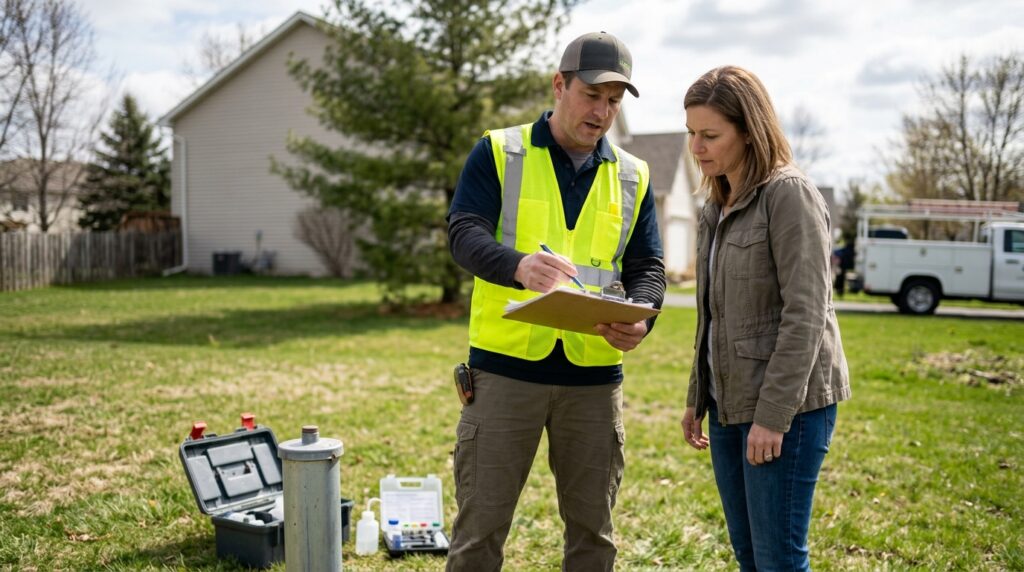
Test once a year for total coliform bacteria, nitrate, pH, and total dissolved solids, as the CDC recommends. Pick the same season each time so you can compare results year to year. Use a state-certified lab, because certified labs follow approved testing methods.
Every Few Years for Metals and Minerals
Water quality stays fairly stable in a well built right, so metals need fewer checks. Metal testing schedules vary, so ask your local health department which tests are appropriate and how often you should repeat them.
After a New Well or Pump Work
Test any new well before you drink from it. Test again after you replace a pump or open the well for repair, because outside dirt and germs can slip in. A fresh bacteria test checks that the work left the water clean.
After Flooding or Nearby Spills
Floodwater can carry germs and chemicals straight into a well. After a flood, do not drink the water until you disinfect and test the well. A nearby spill or leaking fuel tank also calls for fresh tests.
When Taste, Smell, or Color Changes
Your senses provide an early warning. A new metallic taste, a rotten-egg smell, cloudy water, or stains on fixtures all warrant a test. Bacteria, nitrate, and arsenic give no clear sign, so your senses never replace the lab.
Before a Baby Drinks the Water
Test before you mix formula with well water, because nitrate harms infants under six months old. Use bottled water until you know the result. Ask your pediatrician if you have questions about your baby.
Understanding Well Water Test Results
Your lab report lists each test, your result, and a health limit. Compare the two numbers side by side. EPA limits for public water systems can help private-well owners compare results, though they aren’t legally binding for private wells.
Units matter. Results appear in mg/L (parts per million) or µg/L (parts per billion). Nitrate is sometimes reported as nitrate-nitrogen (limit: 10 mg/L) or as nitrate (limit: 45 mg/L). Check which one your lab used.
A result above a health limit calls for action. Switch to a safe water source, then ask a licensed well contractor or your local health department about repairs and treatment; retest after any fix to confirm that it worked.
Treatment should match the problem. A water softener handles hardness, while bacteria require disinfection, and nitrate or arsenic need treatment matched to the contaminant.
Coliform Bacteria in Well Water Signs
Total coliform is colorless and odorless, so sight and smell won’t help you spot it.
- A positive total coliform result from a state-certified lab is the clearest sign.
- A cracked well casing can let bacteria slip into the water.
- A loose or unsealed well cap gives surface contamination an easy path.
- Recent flooding near the well raises the risk of bacteria in the water.
- Stomach illness in your household can be another warning.
- After a positive result, boil water for one minute or use bottled water, then collect a second sample and ask the lab to check for E. coli.
Hard Water vs Contaminated Well Water
Hard water and unsafe water can look alike at the tap, but they are very different problems.
| Feature | Hard Water | Contaminated Well Water |
| Cause | Calcium and magnesium from natural rock | Germs, nitrate, arsenic, or other chemicals |
| Health risk | No health hazard, mostly a nuisance | Can cause illness |
| Visible signs | White scale on fixtures and weak soap lather | Often none, since many threats have no color, taste, or smell |
| How to confirm | Lab test or hardness kit (very hard is above 180 mg/L) | State-certified lab test |
| Typical fix | Water softener | Repairs, disinfection, or a filter matched to the problem |
Frequently Asked Questions
What are the signs of coliform bacteria in well water?
The water looks and smells normal, so only a lab test confirms bacteria. Cracked casings, loose caps, and flooding raise the risk. Boil water for one minute or use bottled water until the retest comes back clean.
How do I tell if it is hard water or contaminated well water?
Hard water leaves white scale and weak lather. Contamination needs a lab test, because germs and chemicals rarely show up on their own.
Where should I start with understanding well water test results?
Match each result with its health limit, then check the units. Call your health department when a number is above the limit.
Can a home test kit replace a lab?
A kit gives a quick hint, but a state-certified lab gives results you can trust for health decisions. Certified labs follow approved methods.
Who can help after a bad result?
Your local health department and a licensed well contractor can explain the next steps for repairs and treatment.
Conclusion
A private well gives you independence, and testing keeps that independence safe. Start with the yearly basics, add metal and local tests on a longer schedule, and read every result against its health limit. Knowing how often to test private well water turns worry into a simple habit. Your family deserves water you have checked, not water you hope is fine. Clean water means little if it arrives in sputters and surges. 77 Water Well can help with fixing well pressure tank cycling, so your pump stops working overtime. Choose us today for safe, steady water!