Summary:
Water well depth varies by local geology, aquifer conditions, groundwater levels, property characteristics, and household demand rather than following a universal standard. In North Houston, evaluating nearby well records, seasonal water levels, and site-specific conditions can help determine an appropriate depth while supporting reliable water supply and realistic project planning.
Anyone planning a new well quickly runs into the same question. How far down does a driller actually need to go before hitting usable water? The honest answer is that it varies more than most people expect, even between two properties on the same road. Depth affects almost everything about a well project, including cost, the type of pump required, and how the finished system performs during a dry summer.
Many homeowners come into this process expecting a single standard number, similar to how a builder might quote a standard foundation depth. Water wells do not work that way. Two lots a short walk apart can call for drastically different depths depending on which sand layer beneath them holds the cleanest, most productive water.
Understanding Water Well Depth
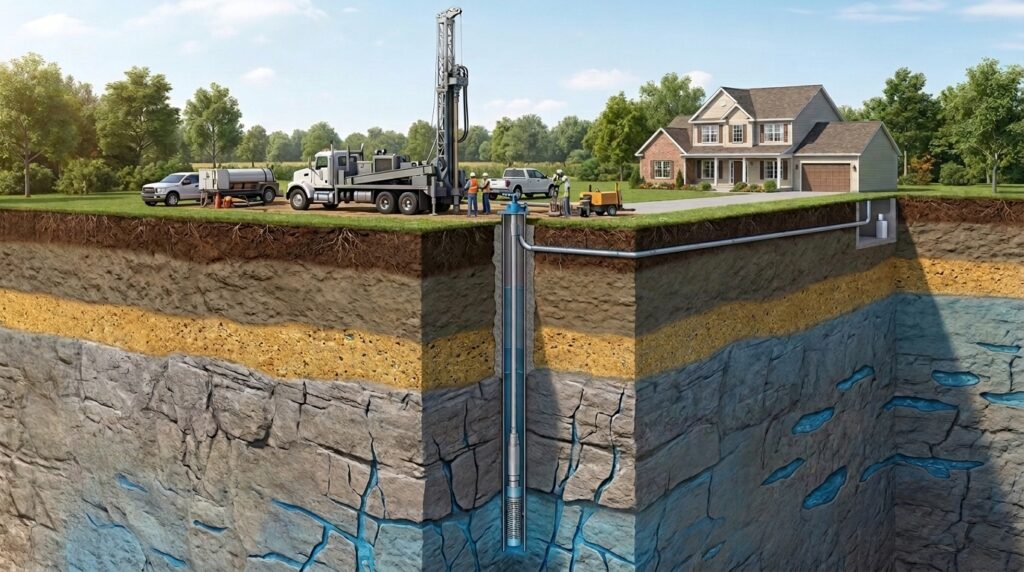
Understanding how deep should a water well be, depends on the groundwater available beneath a specific property rather than a fixed statewide standard. A well must reach a suitable water-bearing formation that can provide enough water for the intended use while meeting applicable construction and regulatory requirements.
In North Houston, local geology and the Gulf Coast Aquifer system play an important role in determining where groundwater can be accessed. Nearby well records can provide useful context, but they do not guarantee the same depth or yield on another property. A licensed well professional can evaluate these conditions and recommend a suitable well design based on the property’s location, expected demand, and groundwater characteristics.
Factors Determining Average Depth of a Residential Water Well
Several factors that determine well depth come into play before a single foot of ground gets drilled. Here is what a licensed driller weighs when recommending a depth for your property.
- Local Geology and Aquifer Type
The Gulf Coast Aquifer beneath North Houston is made up of the Chicot, Evangeline, and Jasper aquifers, each sitting at a different depth and made of different layers of sand, silt, and clay. A driller identifies which layer offers the best combination of yield and water quality for your specific lot. Sand and gravel layers generally produce a steadier flow than a thin clay lens, so a driller studying your property’s geology first can avoid a well that underperforms once it is finished.
- Depth to The Water Table
Groundwater sits closer to the surface in some spots and much farther down in others, even within the same subdivision. Elevation, nearby drainage, and how much water has already been pumped from the area all influence where the water table currently sits. A property near a creek or low-lying drainage area may reach water noticeably sooner than a lot sitting on higher ground just a short drive away.
- Well Yield Needs
A household needing enough water for daily living has different requirements than a property supporting livestock or irrigation. Higher yield needs sometimes call for a deeper well or a wider casing to access a more productive layer of the aquifer. A family of four with a lawn sprinkler system, for example, needs meaningfully more gallons per minute than a household relying solely on indoor fixtures.
- Groundwater Conservation District Rules
Montgomery County falls under the oversight of a regional groundwater conservation district, and local rules can influence permitted depths and required setbacks from property lines, septic systems, and existing wells. Confirming applicable district requirements before drilling can help prevent registration, spacing, or permitting issues that could delay the project.
- Lone Star Groundwater Conservation District
This district manages groundwater use across Montgomery County, including permitting for new wells and monitoring long-term water levels across the Chicot, Evangeline, and Jasper aquifers. Homeowners outside Montgomery County fall under a different district, so confirming jurisdiction early avoids delays.
- Neighboring Well Records
State well logs from nearby properties give a driller a starting estimate for depth and expected yield, though every lot still needs its own site-specific evaluation before drilling begins.
- Seasonal Water Level Changes
Groundwater levels shift with rainfall and regional pumping demand throughout the year. A well drilled a bit deeper than the current minimum requirement gives a household a buffer against seasonal drops, particularly during a dry Texas summer when demand across the region rises at the same time water levels tend to fall.
Well Drilling Depth by Region
Well drilling depthvaries dramatically across Texas because the state covers several distinct geological zones. Coastal areas including North Houston generally see shallower wells drawing from sand and gravel layers, while the limestone formations of the Hill Country often require drilling several hundred feet deeper to reach a productive aquifer layer.
For dependable well inspections, repairs, and maintenance, turn to 77 Water Well, backed by experienced well water experts who understand the needs of North Houston properties.
| Texas Region | General Groundwater Conditions |
| North Houston / Gulf Coast | Sand, silt, clay, and gravel formations associated with the Gulf Coast Aquifer |
| Texas Hill Country | Limestone and other bedrock formations with groundwater conditions varying by location |
| West Texas | Groundwater conditions vary significantly by aquifer, geology, and location |
Signs Your Property May Need a Deeper Well
Several signs can indicate that an existing well may not have enough depth or water availability for the property’s needs. These signs do not automatically mean the well must be drilled deeper, but they can indicate that a professional evaluation is needed.
- The well runs dry during hot weather: If the well provides adequate water during most of the year but struggles during extended dry periods, seasonal groundwater-level changes may be affecting the available supply.
- Water becomes sandier during heavy use: An increase in sand or sediment when water demand rises can indicate that the pump is drawing water under conditions that disturb sediment near the bottom of the well. Other well construction or aquifer issues can also cause this problem.
- Water pressure drops during peak demand: Consistently low pressure when several fixtures operate at once may indicate that the well is not producing enough water for the property’s current demand. Pump or pressure-system problems should also be ruled out.
- Well yield decreases over time: A noticeable reduction in the amount of water a well can produce may indicate changing groundwater conditions, well deterioration, or other issues that require professional testing.
- Water levels decline after nearby drilling: If a neighboring property installs a new well and your water supply changes afterward, increased local pumping may be worth investigating. Groundwater drawdown can affect nearby wells under certain conditions.
- The household’s water demand has increased: Adding irrigation, livestock use, additional bathrooms, or other high-demand applications can place greater demands on an existing well. A system that once supplied enough water may need evaluation if usage has changed significantly.
- The pump struggles during extended use: A pump that runs for unusually long periods or struggles to maintain consistent pressure may indicate a supply or equipment problem. A professional can determine whether the issue is related to well depth, pump capacity, groundwater availability, or another component.
- Nearby well records show significantly greater depths: Records from nearby wells can provide useful information about local groundwater conditions. However, neighboring well depths should only serve as a reference because the appropriate depth can vary between properties.
Frequently Asked Questions
- How deep should a water well be?
There is no standard depth for every water well. The required depth depends on local geology, groundwater levels, aquifer conditions, property characteristics, and household water needs. A licensed well professional can determine an appropriate depth based on site conditions and nearby well records.
- How much does it cost to drill a well?
The total cost varies considerably based on well depth, geology, casing, pump equipment, site conditions, permitting, and other installation requirements. A local drilling contractor can provide a project-specific estimate after evaluating the property.
- How long does it take to drill a residential well?
Drilling time varies based on well depth, geology, equipment access, and site conditions, so the contractor should provide an estimated timeline for the specific property.
- Does a deeper well always mean better water quality?
Not automatically. Water quality depends on which aquifer layer the well draws from rather than depth alone, which is why a professional site evaluation matters more than simply drilling as deep as possible. A shallow well tapping a clean sand layer can outperform a deeper well pulling from a layer with naturally higher mineral content.
Final Thoughts
Well depth in North Houston comes down to geology, groundwater levels, and how much water your household actually needs, not a single standard number that applies to every property. A site-specific evaluation, backed by local well records and current aquifer data, gives homeowners a realistic depth and cost estimate before any drilling equipment shows up. Taking that step first, rather than assuming a depth based on a neighbor’s well or an online average, is the single best way to avoid a budget surprise partway through the project.
Considering new water service in City of Houston? Connect with 77 Water Well to understand your private well options and keep your existing well system operating reliably.